Best States for Hybrid and Remote Work

9 mins read Published: Aug 13, 2026 Last updated: Aug 18, 2026
Hybrid work has settled from a temporary measure to a fixed way of how people work – but where you do it from makes the real difference. Home office days can mean a comfortable dedicated room and gigabit fibre in one state, or a cramped corner and a connection that drops mid-call in another.
To find out where hybrid and remote workers get the best deal, we scored every US state across 12 factors covering the things that actually shape your day-to-day hybrid work routine. Some of the indicators we took into account include: the share of local job listings for remote/hybrid jobs, rent prices and trends, electricity rates and everyday living costs, and more (you can review all of the criteria below).

And because where you live also decides how much of your salary you keep, we have paired the rankings with the two things a map cannot show: the states and cities that will pay you to move there, and the tax rules that can quietly cost a remote worker more than a cheaper rent saves.
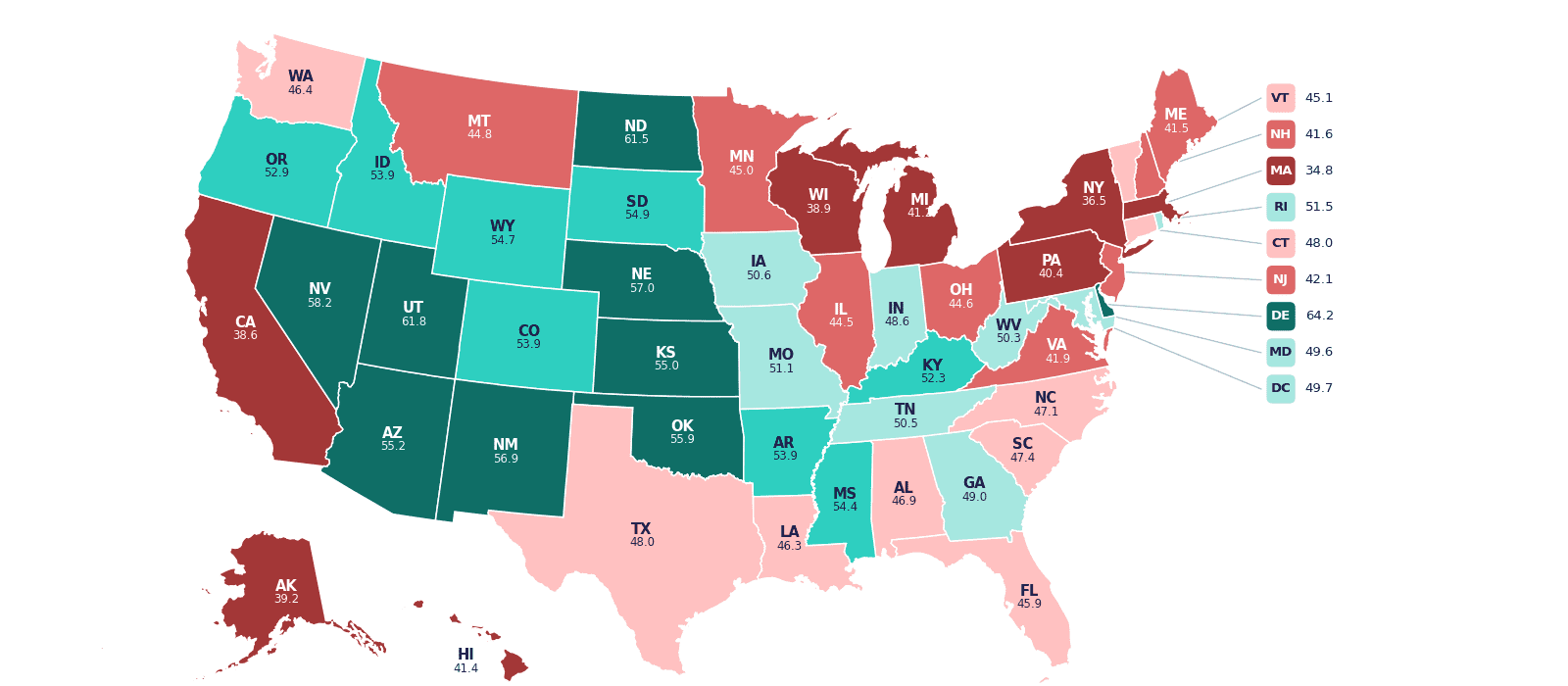
Click through our interactive map below to see where your state ranks.
Delaware is the number one state for hybrid workers, scoring 64.18/100. Out of all jobs available on Glassdoor, 2.25% of those in Delaware have remote and hybrid-remote opportunities, the fifth highest percentage in the country and 111% higher than the national average of 1.06%. On top of this, 97.77% of units in the state have access to at least 100 Mbps download and 20 Mbps upload speeds.
Why it wins: Delaware pulls off the rarest combination in the dataset – a genuinely deep remote job market attached to East Coast infrastructure, without East Coast prices. At 2.25%, its share of remote and hybrid listings is more than double the national average, yet average rent is $1,524 rather than the $2,229 to $3,044 of the states it sits between. Being inside the Philadelphia, Baltimore and Washington corridor means a hybrid worker can still reach three major employment centres for the occasional office day. Its fatal crash rate of 28.7 per 100k registered vehicles is the highest in the index and, under our methodology, a signal of exactly the car-dependent commuting that remote work removes.
Best for: East Coast hybrid workers who still need to be within driving distance of a city office once or twice a week, and anyone hoping to find a remote/hybrid role locally rather than bring one with them.
Utah places second, scoring 61.77/100. The average cost of electricity in Utah is $0.13 per kWh, the fourth lowest in the country. In the state, 35.72% of people work from home at least one day per week, the 4th-highest percentage in the US, while 74.9% of the population lives within half a mile of a park, the third-highest percentage in the country.
Why it wins: Utah wins because of the average home size. A median home of 2,800 sq ft is the largest in the country and roughly 500 sq ft more than second-placed Wyoming – the practical difference between a dedicated office with a door and a laptop at the kitchen table. Pair that with the fourth-cheapest electricity in the US and the running cost of a proper home setup is unusually low. With 35.72% of Utahns already working from home at least one day a week, the Wasatch Front has built its coworking supply, childcare, and daytime economy around hybrid schedules rather than treating them as an exception.
Best for: Families who need square footage and a spare room to work in, and outdoor-oriented workers – 74.9% of the population lives within half a mile of a park, the third-highest figure in the index.
With an index score of 61.46/100, North Dakota comes third. The average electricity price in the state is $0.12 per kWh, the cheapest in the US, and the average rent is $981, the third-lowest overall. North Dakota also has the fastest median upload speed in the country, at 194.04 Mbps.
Why it wins: North Dakota wins on running costs and raw connection quality rather than lifestyle. It has the cheapest electricity in America at $0.12 per kWh, the third-cheapest rent at $981, and the fastest median upload speed in the country at 194.04 Mbps – close to triple the national median. Upload speed is the measure that decides whether a video call holds up and how long a large file takes to send, and it is the one most cost-of-living rankings ignore entirely.
Best for: Bandwidth-heavy workers – video editors, engineers pushing large builds, anyone on camera for most of the day – and, of course, people who’d like to save more in their bank account (who doesn’t!). Less suited to those who want to spend more time in nature, with park access at 37.7%.
Nevada is fourth, with an index score of 58.20/100. In the state, 64.6% of the population lives within half a mile of a park, the 8th-highest percentage in the US. Additionally, 97.77% of units have access to at least 100 Mbps download and 20 Mbps upload speeds.
Why it wins: Nevada has no personal income tax, which is why a lot of remote workers choose it instead of California. Broadband coverage of 97.77% and park access of 64.6% give it big-state infrastructure at mid-market prices, and rent of $1,346 is around 40% below its western neighbor. Las Vegas and Reno also put a major airport within reach, which matters more than people expect once quarterly team travel replaces the daily commute.
Best for: Higher earners relocating from California, where the state income tax savings alone can run to thousands of dollars a year, and people who need to fly frequently on business trips.
Scoring 57.05/100, Nebraska is next. The average cost of electricity in Nebraska is $0.13 per kWh, the third lowest in the country. It also has a median upload speed of 110.18 Mbps, the eighth fastest in the US and 52% higher than America’s average.
Why it wins: Nebraska is the quiet all-rounder. It leads no single category outright, but almost nothing sits below average either: electricity is the third-cheapest in the country, median upload speed of 110.18 Mbps (52% above the national average), and rent stays under $1,150. One caveat the index doesn’t capture: Nebraska is one of a small group of states that applies a convenience-of-the-employer rule, which matters if you work for a Nebraska employer from another state.
Best for: Mid-career workers optimizing for cost and reliability rather than scenery, and hybrid employees who want a short drive into Omaha or Lincoln for occasional in-person days.
On the other hand, the worst state for hybrid-remote workers is Massachusetts, with a score of just 34.78/100. Closely following are New York and California, with scores of 36.45/100 and 38.63/100, respectively.

The bottom of the chart is not a list of bad places to live. It is a list of places where living well as a remote or hybrid worker costs the most. Massachusetts, New York and California combine the highest rents in the index with electricity at $0.29 to $0.33 per kWh and the smallest homes: the median New York home is 1,490 sq ft, barely half of Utah’s 2,800. They also post the thinnest remote job markets in the country – 0.42% of New York listings and 0.47% of Californian ones, against a 1.06% national average – because employers in the densest labor markets have been the quickest to call people back to the office.
Two states fall for less obvious reasons. Hawaii and Alaska score well on remote job availability, at 1.68% and 2.22% of listings, and on lifestyle measures – 82.9% of Hawaiians live within half a mile of a park, the highest figure in the index – but both are dragged down by the two most expensive electricity supplies in the country. That is a cost you pay every hour you are at your home office. Maine and New Hampshire, meanwhile, have the least park access of any state, at 17.4% and 17.2%, despite their outdoor reputation – a reminder that the measure captures walkable everyday green space, not wilderness.
Who should still choose them: Anyone whose industry cluster, family or partner’s career is anchored in a coastal metro. The index measures the cost and practicality of working from home, not career ceiling: Massachusetts and California still concentrate biotech, finance and technology employers, and a remote role paying a Boston or Bay Area salary can comfortably outweigh a lower index score. Within the bottom half, Wisconsin, Michigan and Pennsylvania are the value picks – rents of $1,157 to $1,553 are below the national average, and they rank low mainly on remote job availability rather than affordability.
Ivan Guberkov, Chief Product Officer at OfficeRnD, said the following:
More and more companies are embracing flexible work models not just for economic reasons but to reach more talent as people are drawn to the freedom that hybrid-remote work offers.
Through analyzing a mix of economic and technological factors, this data shows where in the US hybrid-remote work is most viable and serves as a guide for those who value their work set up above other factors such as wages or office perks. This can help employers and employees make more informed decisions about where to live and operate based on their preferred work style.
Our index measures the cost and practicality of working from home. It does not measure what your state takes from your salary before you spend any of it – and for remote workers, who can in principle live anywhere, that is often the single largest financial variable in the decision.
Nine states levy no personal income tax at all: Alaska, Florida, Nevada, New Hampshire, South Dakota, Tennessee, Texas, Washington and Wyoming. New Hampshire is the newest member, having fully repealed its tax on interest and dividends from January 2025. Three of the nine appear in the top eleven of our index, so the tax advantage does not have to be bought at the cost of a poor working environment.
No income tax does not mean no tax, though. New Hampshire carries the highest property tax rate of the nine, Washington taxes capital gains, and Texas and Wyoming lean heavily on property and sales taxes to make up the difference. The saving is real, but it is smaller than the headline implies once a mortgage is involved.
Alaska is the contrarian pick. It ranks 47th on our index, held back by $0.27 electricity and distance, but it is the only state that pays its residents to live there, through the annual Permanent Fund Dividend.
A growing number of states, cities and regions now pay remote workers cash to relocate. The logic is straightforward: someone who arrives with an out-of-state salary spends locally without competing for a local job, so remote and hybrid workers are precisely the target market. Several of the largest programs sit in states that score well on our index – which means the incentive and the working conditions can be stacked rather than traded off.
These schemes open and close with local budgets. Northwest Arkansas’s Life Works Here program, one of the best known, at $10,000 plus a bicycle, has closed to new applicants, and others pause intake between cohorts. So make sure you check the program’s own site and see what the criteria are.

No state wins on every measure, and the right answer depends on which aspects you feel strongly about. Also, hybrid work has moved from a policy to the normal way of working, especially in some parts of the country. This index is also interesting because it shows the locations that would be most appealing to some employees, and companies that want access to talent could consider them as next office locations.
OfficeRnD Workplace handles desk and meeting room booking, shows teams who is coming in on which days so a trip to the office is never wasted. It also has the “Suggested day” functionality, which prompts people to book desks on the days that fellow teammates are in too. If a company is opening a new office in a hybrid/remote friendly state, Workplace provides attendance data to size and shape their space around how it is actually used.


![14 Best Space Management Software Tested and Compared [2026]](data:image/svg+xml;base64,PHN2ZyB2aWV3Qm94PSIwIDAgMTE1MiA3MTkiIHdpZHRoPSIxMTUyIiBoZWlnaHQ9IjcxOSIgeG1sbnM9Imh0dHA6Ly93d3cudzMub3JnLzIwMDAvc3ZnIj48L3N2Zz4=)
The best space management software in 2026 is OfficeRnD Workplace. This is a complete buyer's guide.

The average flex operator connects 1.65 of 5 core systems. See what the gap costs and how to fix it.
A 2-site coworking operator shares how OfficeRnD's AI Sales Agent handles inquiries.
A full year of hybrid work data, taken from our own Workplace product analytics.
OfficeRnD Flex vs Nexudus on pricing, features, and real G2 reviews.
OfficeRnD Workplace vs Robin, full comparison: pricing, adoption, coordination and fit