VAT in the Digital Age (ViDA) is no longer forthcoming law; it is in force. The package was formally adopted by the EU Council on 11 March 2025, published in the Official Journal on 25 March 2025, and entered into force on 14 April 2025.
Implementation rolls out progressively through 2035, but the countdown has already started, and several national mandates are live or arriving in 2026.
For a coworking operator, this means:
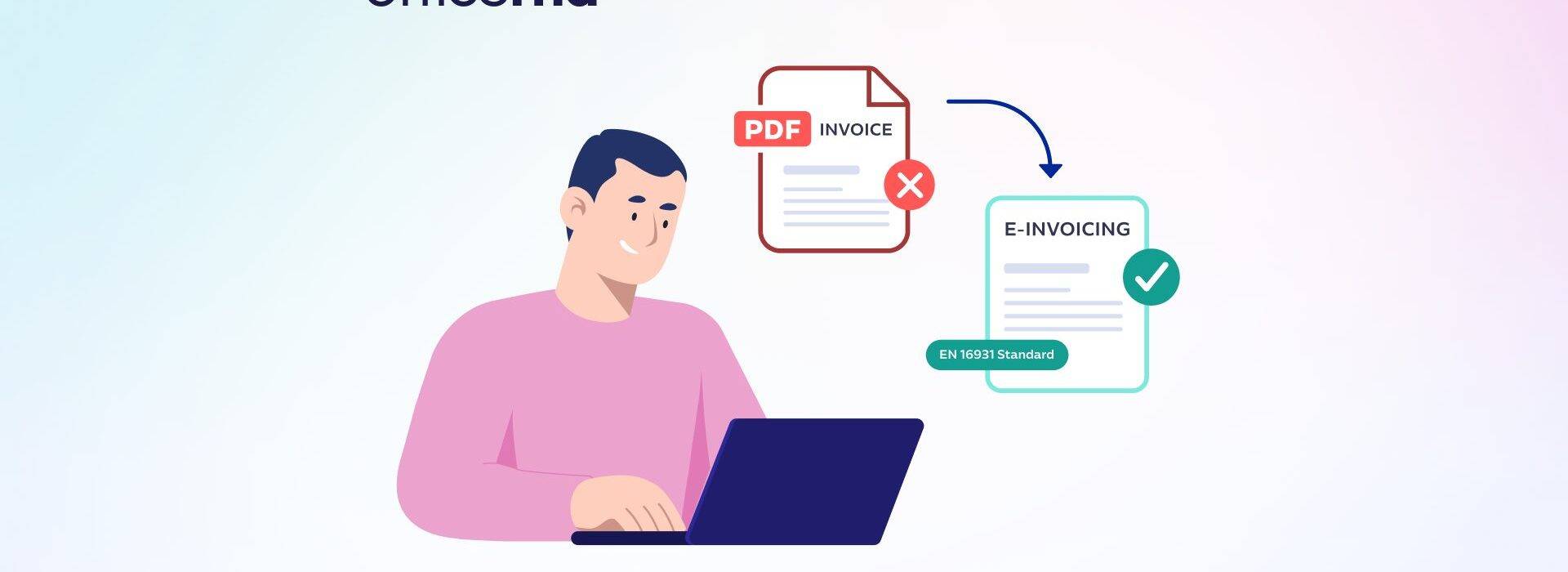
- You must issue and receive structured e-invoices (not PDFs) for in-scope sales.
- You must report invoice data to tax authorities within a short deadline – up to 10 days after the supply or payment for cross-border B2B from 1 July 2030; domestic mandates have their own windows.
- Holding a valid e-invoice is now a substantive condition for VAT deduction – a significant change from the original ViDA proposal. Your clients’ AP teams will enforce this.
- Your tools – billing, accounting, and payment systems must produce EN†16931-compliant e-invoices (UBL or CII formats) and connect to local or EU gateways.
- Your team must collect more accurate customer data (legal entity names, VAT numbers, e-invoicing identifiers) and adhere to stricter credit note and correction rules.
It is a big change, but it is doable if you start now. In this blog, we will list the most important information you must know to be prepared.
What is ViDA, in plain words
ViDA is the EU’s programme to modernise VAT for the digital economy. It has three pillars:
- E-invoicing and Digital Reporting Requirements (DRR) for cross-border B2B and, progressively, alignment of domestic systems.
- Platform economy rules – VAT obligations for short-term accommodation and passenger transport platforms (deemed-supplier rules apply from 1 July 2028, optionally from July 2026).
- Single VAT Registration improvements – expanding One Stop Shop and simplifying cross-border compliance (OSS extended from July 2028).
For coworking, the most important piece remains e-invoicing and DRR. Focus there first.
If you use OfficeRnD Flex, you don’t need to build your compliance stack from scratch. Flex generates structured invoices in the formats your country requires, routes them through Peppol or national networks, and handles validation and reporting automatically, so you’re not chasing rejections or manually filing after the fact. And unlike most coworking and flex space platforms, it’s included out of the box at no extra cost. Particularly useful if you invoice B2B clients across multiple EU countries.
See how it works.Key dates you should track (updated for 2026)
Already live – Italy: Italy has operated mandatory B2B e-invoicing via its SDI (Sistema di Interscambio) platform since 2019, making it the longest-running domestic mandate in the EU. If you have Italian operations or invoice Italian businesses, SDI compliance is a pre-existing requirement, not something to plan for.
14 April 2025 (already passed): ViDA entered into force. Member States can now mandate domestic B2B e-invoicing without seeking European Commission approval. Buyers can no longer legally refuse to receive structured e-invoices.
1 January 2026 – Belgium (live now): Mandatory B2B e-invoicing for all Belgian-established VAT-registered businesses, using Peppol BIS 3.0 / UBL 2.1.
A three-month tolerance period (Q1 2026) applies for businesses that can demonstrate good-faith compliance efforts and genuine technical difficulties. From 1 January 2028, Belgium adds continuous transaction reporting (Peppol 5-corner model).
1 February 2026 – Poland (large taxpayers): KSeF 2.0 clearance e-invoicing goes live for businesses with 2024 turnover above PLN 200 million.
The KSeF system is a central government clearance platform – invoices must be validated there before they are legally issued. An 11-month penalty-free soft-landing runs through December 2026.
1 April 2026 – Poland (all other VAT-registered businesses): KSeF extends to the vast majority of Polish VAT-registered businesses. Micro-entrepreneurs (monthly sales under PLN 10,000) follow on 1 January 2027.
13 February 2026 – EN†16931-1:2025 standard approved: CEN formally approved the updated EU e-invoicing semantic standard, now rewritten for B2B transactions (not just B2G). Full publication is expected by May 2026.
This is the technical backbone of ViDA’s DRR requirements.
September 2026 – France (receiving mandate): All French businesses must be capable of receiving structured e-invoices.
Large enterprises (over €1.5 billion turnover) and mid-sized businesses (€250 million–€1.5 billion) must also issue e-invoices from this date. SMEs and micro-businesses follow on 1 September 2027.
2027 – Germany (large companies): Businesses with turnover above €800,000 must issue structured e-invoices for domestic B2B sales.
Note: receiving e-invoices has been mandatory in Germany since 1 January 2025. The transition window (2025–2026) allows continued use of paper or legacy PDF invoices for issuing.
By 31 December 2026: EU Member States must transpose the ViDA Directive into national law.
1 January 2028 – Germany (all businesses): E-invoicing mandate extends to all German businesses for domestic B2B transactions.
1 July 2028: OSS expansion for domestic B2C supplies and mandatory reverse charge mechanism. Platform deemed-supplier rules become mandatory for accommodation and transport platforms.
1 July 2030: Cross-border B2B e-invoicing and Digital Reporting Requirements go live EU-wide. E-invoices must be EN†16931-compliant, issued within 10 days, and reported near-real-time. The EC Sales List (ESL/recapitulative statement) is abolished and replaced by DRR.
By 1 January 2035: All domestic e-invoicing and reporting systems, including pre-existing ones like Italy’s SDI must align with EU standards.
Your practical timeline: national mandates are arriving now. If you operate in Belgium, Poland, France, or Germany, your 2026 preparation window is already open or already closed. Treat 2026–2028 as your full-implementation window for all markets.
What “e-invoice” means – and what has changed
Under ViDA, an invoice is not a PDF you email. An e-invoice is a structured data file that a machine can read without human intervention. The EU standard behind it is EN†16931, implemented through two main syntaxes:
- UBL (Universal Business Language)
- CII (UN/CEFACT Cross Industry Invoice)

Important update: EN†16931-1:2025. The original 2017 standard was designed for public procurement (B2G). CEN approved a significant revision on 13 February 2026, specifically adapted for B2B transactions.
The updated standard adds new data fields for DRR reporting (including IBAN, corrective invoice numbering, early payment discounts, FX data, and a broader range of VAT scheme codes).
It is expected to be formally published by May 2026 and will be the reference standard for the 2030 DRR mandate.
E-invoice as a VAT deduction condition. A key change from the original ViDA proposal: holding a valid e-invoice for eligible intra-EU B2B transactions will become a substantive condition for VAT deduction or reclaims.
This means your business customers cannot recover input VAT without a compliant structured e-invoice from you – expect enterprise buyers to enforce this in their AP workflows well before 2030.
PDFs may still accompany an e-invoice for human readability, but the authoritative, legal record is the structured data file.
What changes for coworking spaces day to day
Coworking billing is a mix of recurring memberships, meeting room bookings, and ad-hoc charges (day passes, printing, lockers, events). ViDA does not change what you sell. It changes how you invoice and report it.
1) Issuing invoices faster
- For cross-border B2B sales (from July 2030): issue the e-invoice within 10 days of the supply or payment, whichever comes first.
- For domestic mandates already live (Belgium from January 2026, Poland from February/April 2026, France from September 2026): follow local deadlines.
- Batch invoicing “whenever we get to it” will not cut it. You need billing jobs that run at least daily, ideally immediately after a chargeable event.

2) Reporting data quickly
- For in-scope transactions, submit a subset of invoice data to the tax authority within the same short window.
- In some countries (e.g., Poland’s KSeF), the invoice must be cleared through a government platform before it is legally valid at all.
- Buyer-side reporting (for self-billing or intra-EU acquisitions) has a 15-day window from the chargeable event.
3) Collecting better customer data
At onboarding, capture:
- Legal entity name (exactly as registered)
- VAT number and country of registration
- Registered address and place-of-supply details
- E-invoicing identifiers (e.g., Peppol ID, KSeF identifier for Polish clients, SIRET/SIREN for French clients)
- Purchase order numbers / buyer references where clients require three-way match
4) Cleaning up invoice corrections
- No deleting and re-issuing. Use credit notes that reference the original invoice.
- Keep consistent numbering. Some systems (e.g., KSeF) require corrective invoice sequential numbering.
- Align rounding and tax rules across your systems to avoid mismatches.
5) Making refunds traceable
- Link refunds to the original invoice and payment.
- Reflect partial refunds with partial credit notes.
6) Getting paid
- Offer common EU rails (bank transfer with structured remittance, card, SEPA direct debit).
- Include payment references and IBAN details on e-invoices (IBAN is now a new field in EN†16931-1:2025).
- For subscriptions, ensure mandates and pre-notifications meet SEPA rules.
Country-by-country: the 2026 landscape
The domestic mandate wave has accelerated sharply. Here is where the major markets stand as of February 2026:
Belgium – Live from 1 January 2026
All Belgian VAT-registered businesses must issue and receive structured e-invoices for domestic B2B transactions. Format: Peppol BIS 3.0 / UBL 2.1 via the Peppol network. PDFs are no longer compliant.
A three-month tolerance period applies for businesses demonstrating good-faith efforts. E-reporting (continuous transaction control via Peppol 5-corner) follows in 2028.
Poland – KSeF rolling out from February 2026
Poland operates a clearance model: invoices must be submitted to and validated by the central KSeF platform before they are legally issued.
Large taxpayers (2024 turnover above PLN 200 million) from 1 February 2026; all other VAT-registered businesses from 1 April 2026; micro-entrepreneurs from 1 January 2027. No financial penalties during 2026 (soft-launch).
The FA(3) XML schema is required. KSeF holds invoices for 10 years as the official archive.
France – Receiving mandate from September 2026
All businesses must be capable of receiving e-invoices from 1 September 2026. Large and mid-sized companies must also issue from the same date. SMEs and micro-businesses begin issuing from 1 September 2027.
French and German national e-invoicing standards (including ZUGFeRD / Factur-X and XRechnung) were updated on 15 January 2026 to align with EN†16931-1:2025.
Germany – Receiving mandatory since January 2025; issuing from 2027
Receiving structured e-invoices has been mandatory for all German businesses since 1 January 2025. Issuing mandatory: large companies (turnover above €800,000) from 1 January 2027; all businesses from 1 January 2028.
During the 2025–2026 transition, paper and legacy PDFs remain valid for issuing. Formats: XRechnung and ZUGFeRD (both EN†16931 compliant).
Italy – Already established
SDI (Sistema di Interscambio) has been in place for B2B since 2019. Italy must align SDI with EU standards by 2035. If you have Italian operations, SDI compliance is already a requirement.
Romania – RO e-Factura active and expanding
Romania’s RO e-Factura mandate continues to expand. If you operate in Romania, verify current scope with a local adviser.
Croatia – Mandatory from January 2026
Croatia published updates to its Fiscalization Law in June 2025, with mandatory e-invoicing from 1 January 2026.
Greece – Phased from February 2026
Greece mandated B2B e-invoicing for large enterprises (gross revenue over €1 million) effective 2 February 2026, with Phase B starting in October 2026.
Spain, the Netherlands, and others
Spain is implementing VeriFactu – a hybrid verification system. Watch for domestic mandate announcements.
Several other Member States are expected to introduce mandates during 2026–2027 now that EU approval is no longer required.
Do not try to memorise every nuance. Build a monitoring habit: track the countries where you operate and your top customer countries, subscribe to a reputable EU VAT news source, and bookmark the
European Commission’s e-invoicing country factsheets (updated regularly).
Cross-border vs. domestic: how scope works
- Cross-border B2B (intra-EU): E-invoicing and DRR mandatory from 1 July 2030. Your invoices must be EN†16931-compliant and reported within 10 days.
- Domestic: Depends on your country. Belgium and Poland are live now. France and Germany are phasing in through 2027–2028. Check your country of registration and the countries where you have a VAT registration.
- B2C: ViDA does not impose an EU-wide B2C e-invoice mandate. Individual countries can extend requirements — watch local rules.
Practical tip: Map your sales by customer type (business vs. consumer) and location (domestic vs. other EU vs. non-EU). That tells you which flows must change first and which national mandate hits you earliest.
What coworking sales are in scope
Common coworking lines and how they typically fit:
- Memberships and dedicated desks: Taxable services. B2B cross-border sales will require EN†16931 e-invoicing and DRR from July 2030. Domestic mandates may pull these in sooner.
- Meeting rooms and event space: Taxable; watch for different local VAT rates, catering vs. room rental splits, and place-of-supply rules.
- Day passes and hot desk time: Taxable B2C in most cases; B2B if invoiced to a company. Domestic mandates may bring these into e-invoicing earlier.
- Virtual office / mail handling: Often taxable; collect the service address and legal name carefully to avoid KYC and VAT ID issues.
- Locker / storage, printing, parking: Usually taxable add-ons; ensure tax codes are correct in your price book.
This is general guidance. Local VAT rules differ. When in doubt, ask a VAT adviser in your country.
The data model you need to support
Your billing and accounting stack should be able to populate, at minimum, these EN†16931-1:2025 core elements:
- Seller and buyer details (names, addresses, VAT IDs, Peppol or national e-invoicing identifiers)
- Document type (invoice, credit note, self-billing invoice, corrective invoice with sequential numbering)
- Invoice issue date and supply date (or period)
- Line items with quantities, prices, discounts, VAT rates, and tax categories
- Totals (net, tax, gross) with rounding rules aligned to your country’s requirements
- Payment terms and methods, including IBAN details (new in EN†16931-1:2025)
- References (PO, contract, original invoice for credit notes, KSeF number for Polish invoices)
Ask vendors explicitly: Can you produce EN†16931-1:2025-compliant UBL/CII? Can you transport via Peppol or our national network? Can you handle KSeF clearance for Polish invoices and France’s platform for French invoices?
Systems and integrations: what to change
Your goal is a touchless flow: from a booking or membership action to a compliant e-invoice, then to payment and reconciliation, with reporting handled in the background.

1) Coworking system ↔ e-invoicing provider
- Ensure your coworking/billing platform generates EN†16931-compliant data for every invoice and credit note.
- Integrate with an e-invoicing service that supports your countries’ channels (Peppol, national platforms, KSeF for Poland, national platform for France) and DRR reporting.
- Validate VAT IDs at creation time and block invoicing until buyer data is complete.
2) Accounting ↔ e-invoicing
- Sync invoice statuses, payments, and credit notes back to your general ledger.
- Keep tax codes and VAT reporting logic consistent across systems.
3) Payments ↔ invoicing
- Embed payment links with structured remittance so you can auto-match.
- Automate dunning and late-fee rules within the legal limits of your country.
4) Document storage & audit
- Store the structured invoice file plus a human-readable rendering.
- Keep immutable logs of submissions, acknowledgements, and rejections.
- Apply retention rules by country — often 7–10 years (Poland’s KSeF retains invoices for 10 years centrally, but verify local rules for any additional obligation).
Contracts, pricing, and terms: small but important tweaks
- Invoice timing: Define when an invoice is deemed issued (e.g., upon booking, upon service start, upon payment). This matters for the 10-day rule and for clearance systems like KSeF.
- Self-billing: Allowed, but self-billing has a 5-day deadline from the supply under ViDA. Confirm responsibilities in the contract and test the flow, especially for KSeF-registered Polish clients.
- Credit notes: Document when you issue them (cancellations, proration, refunds). Reference the original invoice ID. Some systems require corrective sequential numbering.
- POs and references: If enterprise buyers need PO numbers or Peppol IDs, capture them in the customer record so your e-invoices pass their AP checks and qualify for their VAT recovery.
- E-invoice acceptance: Buyers can no longer refuse structured e-invoices. Update your standard terms to reflect this.
Multi-site, cross-border operations
If you run locations in several countries, you may have multiple VAT registrations. Practical steps:
- Keep a clean entity → location → VAT number mapping.
- Decide where each invoice is issued from and under which VAT ID.
- Maintain country-specific tax codes, rates, and e-invoicing channel configurations.
- For countries with clearance systems (Poland’s KSeF), ensure your e-invoicing provider can handle the government platform integration, not just Peppol.
- Centralise templates and approval rules, but allow local overrides where the law requires it.
Governance, controls, and risk
ViDA raises the bar on invoice integrity and authenticity. So, strong business controls are essential:
- Maker–checker approval for price books and tax settings.
- Access control on issuing, cancelling, and crediting invoices.
- Automated validation for missing VAT IDs, invalid addresses, or incorrect tax categories.
- Monitoring dashboards for rejected e-invoices, late submissions, and unmatched payments.
- Clear SOPs for handling corrections, customer data changes, and refunds.
Treat this like access control in your buildings: least privilege, audit logs, alerts when something looks off.
Data protection and retention
- E-invoicing moves more data between systems. Review your privacy notices and data processing agreements with providers.
- Limit who can download structured invoices; they are rich in company data.
- Apply retention rules consistently. Purge test data so it does not appear in production reports.
- For KSeF-submitted invoices in Poland, the government platform retains copies for 10 years; ensure your own retention policy accounts for this.
E-invoicing readiness checklist for coworking space operators
If you operate in Italy – required since 2019
- Ensure all domestic B2B invoices are issued and received via SDI (Sistema di Interscambio).
- Verify your XML format (FatturaPA) is current and your SDI integration is active.
- Plan for alignment with EU standards by the 2035 deadline — your provider should have a roadmap.
If you operate in Belgium – required now
- Issue and receive structured e-invoices via Peppol BIS 3.0 / UBL 2.1.
- Ensure all Belgian B2B customers have Peppol IDs or alternative EN†16931-compliant channel.
- If still preparing: document good-faith efforts before the Q1 2026 tolerance period ends.
If you operate in Poland, required from February/April 2026
- Integrate with KSeF 2.0 API or work with a provider that has done so.
- Collect KSeF identifiers for your Polish B2B clients.
- Obtain authentication certificates well ahead of your phase deadline.
For all EU operators – within 90 days
- Map your revenue flows: memberships, bookings, add-ons; mark domestic vs. cross-border and B2B vs. B2C.
- Gap-check your current invoices against EN†16931-1:2025 core data elements.
- Pick an e-invoicing provider (or confirm your existing vendor’s roadmap) for each country where you operate, covering Peppol, KSeF, France’s platform, and national alternatives.
- Start capturing VAT IDs, legal names, Peppol IDs / national identifiers, and buyer references for all B2B customers.
- Turn on VAT ID validation during account creation.
In the next 6–12 months
- Build or activate the integration between your coworking platform and the e-invoicing provider.
- Pilot UBL/CII issuance to a few willing business customers; send via Peppol or your national channel.
- Adjust invoice schedules to meet the relevant country deadlines for in-scope sales.
- Implement credit note flows with proper reference chaining (no manual deletes).
- Train front-of-house and finance teams on data to collect and how to handle corrections.
By 2027–2028
- Extend structured e-invoicing to all B2B where your country requires it.
- Automate digital reporting alongside issuance so the two always happen together.
- Add monitoring for submission rejections and late reports.
By mid-2030
- Ensure every cross-border B2B invoice is EN†16931-compliant, sent through the right channel, and reported within 10 days.
- Phase out any legacy invoice templates that cannot produce structured data.
- Ensure your systems support the updated EN†16931-1:2025 standard for DRR reporting.
A practical project plan you can copy
1) Form a small core team. Finance lead, ops/IT lead, one location manager. Give them authority to make process changes.
2) Pick your providers. Shortlist 1–2 e-invoicing vendors that cover your countries, Peppol, and country-specific platforms (KSeF, future French platform). Confirm EN†16931-1:2025 support and DRR alignment.
3) Clean your customer data. Run a VAT ID audit. Fill missing addresses, Peppol IDs, and buyer references. De-duplicate accounts.
4) Build the integration. Start with invoice creation and credit notes. Add status callbacks (accepted/rejected/cleared).
5) Pilot. Choose 3–5 B2B customers in another EU country or in a country with an active mandate. Exchange real e-invoices end-to-end and fix gaps.
6) Roll out. Country by country, starting where domestic mandates hit first (Belgium, Poland, then France/Germany).
7) Monitor. Add dashboards for late issuance, failed submissions, and unmatched payments.
8) Document. Update SOPs. Train staff. Refresh your privacy notices to reflect new data flows.
Common pitfalls to avoid
- Treating PDFs as “good enough.” They are not, for in-scope transactions. Clients in Belgium and Poland are already receiving consequences.
- Ignoring buyer data. Missing VAT IDs, Peppol IDs, or KSeF identifiers will block e-invoice delivery and could cost your clients their VAT deduction.
- Manual corrections. Use credit notes that reference the original invoice ID. Some platforms require corrective sequential numbering.
- One-off country hacks. Choose vendors and formats that scale across the EU.
- Late batching. Move to daily or event-based invoice runs, especially for countries with tight clearing windows.
- Assuming your existing provider is ready. Ask explicitly: does your software support KSeF clearance? The French national platform? EN†16931-1:2025?
Why this is worth it (beyond compliance)
- Faster payments. Clean, structured invoices pass AP checks and flow through matching rules without manual handling.
- Fewer disputes. Clear references, consistent tax, and traceable corrections reduce back-and-forth.
- Better cash visibility. Real-time reporting and reconciliation improve forecasting.
- Lower audit stress. Standardised data and receipts cut the time you spend answering tax authority questions.
- Competitive advantage. Enterprise clients increasingly choose suppliers who make their AP process easy. A clean e-invoicing setup is becoming a procurement requirement, not just a compliance checkbox.
What’s Next?
ViDA is no longer on the horizon; it is here. Italy and Belgium’s mandates are live. Poland’s is rolling out. France and Germany are months away. The EU standard has been updated for B2B. The only remaining question is how ready you are.
Start with the basics: get your customer data right, pick a provider that speaks EN†16931-1:2025 and Peppol (and KSeF, and whatever France builds), and wire your systems so invoices go out and get reported on time. Do that, and the rest is maintenance.
If you want a platform that takes e-invoicing off your plate while also cutting the busy work and helping you grow, OfficeRnD Flex is built for coworking operators who want less time firefighting compliance and more time focused on their members and their bottom line.
Book a live demo here.
FAQ
Do I need e-invoices for B2C members?
Not under the EU rule by default. But your country may extend domestic e-invoicing or e-reporting to B2C. Check local guidance.
Can I keep sending PDFs?
Not for in-scope transactions in countries with active mandates (Belgium, Poland, and others). A PDF attachment alongside a structured file may be accepted for human readability, but the structured file is the legal invoice.
What if a client’s AP system won’t accept our e-invoices?
Ask for their accepted channel (Peppol, KSeF, national platform, specific provider) and their identifiers. Clients in Belgium and Poland cannot legally refuse structured e-invoices under the new ViDA framework. Send test invoices before go-live.
What is the penalty for missing the 10-day window?
Penalties are set by each Member State and vary. Belgium starts at €1,500 for a first offence. Poland’s soft-landing means no penalties during 2026, but enforcement starts in 2027. Automate issuance and reporting; do not rely on grace periods.
Does ViDA change VAT rates for coworking?
No. It changes how you invoice and report, not your rate. Keep your country-specific tax codes current.
We use self-billing with a few enterprise clients. Is that allowed?
Yes, but there are extra reporting rules and tight deadlines (5 days after the supply for self-billing under ViDA). For KSeF in Poland, self-billing arrangements have specific rules. Put responsibilities in the contract and test the flow.
What is the ESL and will it still apply?
The EC Sales List (also called the recapitulative statement) is the periodic report businesses currently file for intra-EU B2B supplies. Under ViDA’s DRR, the ESL is abolished from 1 July 2030 and replaced by near-real-time transaction-by-transaction reporting. Update any processes that rely on ESL data.
Is this only about finance?
Mostly, but it touches member onboarding (data collection), sales ops (customer identifiers and PO numbers), IT (integrations), legal (contract terms), and your privacy notice. Treat it as a cross-team project.
References:
ViDA – Adoption & official sources
- European Commission — Adoption of the ViDA package
- European Commission — ViDA main hub
- Norton Rose Fulbright — ViDA package finally adopted
- PwC Luxembourg — ViDA: What you need to know
- Sovos — ViDA: The Timeline
Belgium – Live from 1 January 2026
Poland – KSeF 2.0 from February 2026
France – Mandate from September 2026
Germany – Receiving mandatory since January 2025
EN 16931-1:2025 – Updated standard



![14 Best Space Management Software Tested and Compared [2026]](data:image/svg+xml;base64,PHN2ZyB2aWV3Qm94PSIwIDAgMTE1MiA3MTkiIHdpZHRoPSIxMTUyIiBoZWlnaHQ9IjcxOSIgeG1sbnM9Imh0dHA6Ly93d3cudzMub3JnLzIwMDAvc3ZnIj48L3N2Zz4=)
