Turn Your Coworking Website Into Your Highest-Performing Revenue Channel [Webinar Recap]

14 mins read Published: Mar 30, 2026 Last updated: Oct 16, 2026
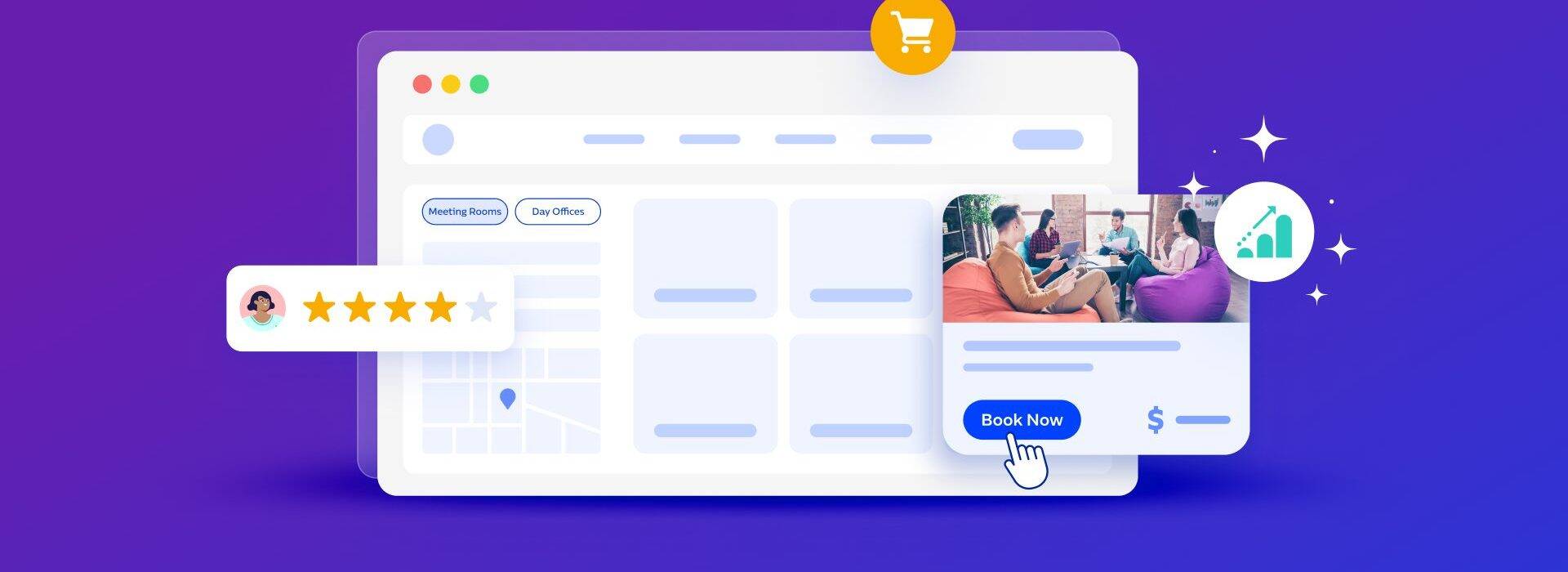
Your coworking website has one job: turn curious visitors into paying customers. But for most operators, it’s quietly leaking revenue every single day – through confusing layouts, missing booking flows, and marketing spend that can’t be measured.
In our recent webinar, “Turn Your Coworking Website Into the Highest-Performing Revenue Channel”, three product and marketing experts from the team walked through exactly how to fix that. Here’s what they covered, and what you can start acting on today.

Assen Tzekin, OfficeRnD’s Principal Product Designer, opened with a point that resonates with anyone who’s poured time, money, and energy into building a great physical space: your digital presence deserves the same investment as your four walls.
Before a visitor ever books a tour or submits an inquiry, your website is already forming an impression. Assen’s advice: use color, imagery, and language to translate the feel of your physical space into the digital experience.
Think of it as creating a consistent “aha moment”, so when someone walks through your door for the first time, it feels exactly like they expected from browsing your site. As Assen put it:
Ask yourself, what are the specific visual clues I can include in my website that will prepare my visitors for that moment? So when they go through my door, they get the same feeling they got when they were browsing my digital space.
One underrated element is language, not just tone, but literally which languages your site supports. If a meaningful portion of your community speaks something other than your default language, your website might be closing the door before they even knock.
Assen frames multilingual support as an act of hospitality: removing barriers before people arrive. To make the written experience even more accessible, tools like Lara Translate, for example, can help translate website copy, booking information, and member-facing documents before local review.

Every page on your site should have one clear primary action and one secondary option. No more, no less. Assen calls this eliminating “analysis paralysis” – when visitors face too many options, they often choose none.
For a coworking space, the most common options are Book a Tour and Book Online, but which one takes the primary spot depends on your business model. Some operators lead with online booking, others prioritize tour requests first. You might even have a single action that makes the most sense for your setup. The point isn’t which one goes first. it’s that you make a deliberate choice and stick to it.
A few CTA best practices Assen shared:
Every page should be a pathway, not a dead end. Assen outlined three principles for a website layout that actually converts:
A slow website doesn’t just frustrate visitors, it destroys the brand experience you’ve worked hard to build. Assen is direct about this: if your images load slowly, visitors don’t experience your brand, they experience frustration.
Beyond speed, he introduced the concept of “invisible precisions” – small technical details that seem minor until they’re missing.
Something as simple as a shareable link to a specific meeting room can meaningfully affect how people recommend and promote your space on social media or by email.
With 30–40% or more of website traffic coming from mobile devices across OfficeRnD’s customer base, building for desktop first is no longer an option.
Assen frames this around the “flexible worker”, someone who makes decisions on the move and expects to convert a thought into a booking with a thumb tap.
If your website doesn’t meet them there, they’ll find one that does.
Great design means nothing without traffic. Silvia Ivanova, OfficeRnD’s Demand Generation expert, walked through how to think about marketing in a way that actually maps to how customers buy.
Before someone books a desk or a tour, they typically go through three stages:
The key insight: most operators only run campaigns targeting stage three. But if no one knows you exist and hasn’t already compared you favorably against alternatives, a conversion-focused ad campaign will underperform no matter how good the offer is.
Silvia’s recommendation is to run campaigns that support all three stages simultaneously:
Silvia focused specifically on channels that are measurable online:
Google Search (paid and organic) is best for capturing high-intent searches – people actively looking for “coworking space near me” or “coworking in [city].”
Silvia also gave a heads-up on AI-powered search tools like ChatGPT and Perplexity gaining ground, but her advice for now: don’t abandon Google, it still holds the majority of search market share.
Social Media (Instagram, TikTok, LinkedIn) works best for visibility and community storytelling, showcasing the vibe of your space and the people who work there.
Email typically delivers the highest conversion rates of any channel, because you’re talking to people who already expressed interest. Use it to promote new availability, seasonal offers, and new locations.
Retargeting is a high-ROI channel that’s often underused. Running ads to people who visited your pricing page but didn’t book, or who added a product to their cart but left – these audiences are warm and often just need a small nudge.
Here’s the honest truth about marketing: if you’re not tracking properly, you’re guessing. Silvia walked through the mechanics of using Google Analytics 4 (GA4) as your measurement hub, and why UTMs are the backbone of understanding which campaigns actually drive revenue.
UTMs are tracking labels appended to your campaign URLs that tell GA4 where a visitor came from, how they got there, and which campaign brought them. With UTMs set up across all your channels, GA4 can show you:
Silvia shared a telling example from the webinar: if your Google paid spend is under $15,000–$20,000, it’s likely your best-performing channel. But if you’re spending more than that, a well-executed email campaign with zero ad spend might be generating more revenue (in her example, $30,000). Silvia said it very well:
You should be sure to drive all the traffic you generate to your website, and that’s where you start tracking key actions — tour bookings, contact form submissions, website purchases.
The key metric for conversion campaigns? ROAS – Return on Ad Spend. A healthy benchmark is 3–4x: for every dollar you put in, you get three to four dollars back.
For awareness campaigns, focus on reach combined with engagement rates (reach alone tells you nothing about whether you’re reaching the right people).
Once you’ve got a well-designed website bringing in qualified traffic, the final piece is making it dead simple to turn visitors into paying customers – automatically, without staff involvement.
That’s what Radoslav (Rado) Enchev, Senior Product Manager for Growth Hub, covered in the final third of the webinar.
Growth Hub is OfficeRnD Flex’s e-commerce layer – it sits between your website and the OfficeRnD backend, enabling visitors to discover, book, and pay online for the products you offer.
Crucially, it’s built with all the design and tracking principles covered earlier baked in: it’s embeddable in your existing website, customizable to match your brand, and natively integrated with GA4 for full e-commerce event tracking. As Radoslav said:
The best part of it is that it generates revenue for you 24/7, even when your team is not there.
Not everything needs to be automated. Rado was clear that products like private offices (long-term), event venues, and large enterprise deals benefit from human conversation, they involve negotiation, relationship, and complexity that doesn’t lend itself to self-serve.
But a significant portion of what most operators sell – day passes, meeting rooms, day offices, and coworking memberships are high-volume, low-complexity purchases. There’s no good reason to route these through an inquiry form or involve staff time.
Rado’s advice: start with the top-left quadrant of the product matrix – high volume, low purchase complexity, and work your way across. That’s where the effort-to-impact ratio is best and where you’ll see results fastest.
Some operators using Growth Hub are now completing 60–70% of their day pass sales entirely online, with zero staff involvement, directly improving profitability per transaction.
By the time someone lands on your website, they’ve often already decided they want to use your space.
They heard about it from a colleague, walked past it, or found it on Google Maps. At that point, every extra step between them and a booking is a risk of losing them. Getting your core products bookable online removes that friction.
Private offices are typically your largest inventory category, and between tenants, they generate zero revenue while you’re still paying rent.
The concept of daily offices isn’t new, but historically it’s been operationally painful: manual availability checks, double-booking risks, and no easy way to distinguish between long-term and short-term inventory.
Growth Hub automates all of that. Set daily or hourly rates for the same offices you rent long-term, and the system automatically makes them available only during periods with no active contract.
No manual checking, no admin overhead. Roto’s research suggests the sweet spot for daily offices is 2–10 person spaces, primarily serving small remote teams who need to gather once or twice a month.
The data across OfficeRnD’s customer base confirms a pattern every operator already knows anecdotally: meeting rooms are nearly empty on Friday afternoons, slow on Monday mornings, and in high demand Tuesday–Thursday around midday.
Growth Hub now supports dynamic pricing rules based on these demand patterns. Increase prices by 10–15% during peak hours (when rooms will likely book anyway), and discount off-peak slots that would otherwise sit empty.
The platform provides heat map dashboards showing booking patterns by day, time, and revenue, so you can make these decisions based on real data, not gut feeling.
This is a feature launching imminently at the time of the webinar: automated abandoned checkout recovery emails.
The scenario is common – someone goes all the way to the checkout, their phone rings, and they never come back. With this feature, Growth Hub automatically sends a recovery email to those high-intent visitors who didn’t complete their purchase.
Based on benchmarks from traditional e-commerce and the hotel industry, similar features recover between 5–15% of abandoned checkouts. Rado noted that while coworking has lower overall traffic volumes than traditional e-commerce, purchase intent tends to be significantly higher, which could mean strong recovery rates.
During the webinar, attendees submitted a range of great questions. Here are the answers from the team:
Q: If you have a limited or no budget as a new small business, what are the best marketing channels and campaigns to use?
Start with a small Google retargeting campaign targeting people who visited your homepage, pricing page, or added items to their cart but didn’t check out.
Offer something special to that warm audience to reduce abandonment. If the budget is even tighter, activate local partnerships and community groups – incentivize them to refer people to your space. Word of mouth is free and genuinely effective for local businesses.
Q: How can I do the same event capture in Meta (custom purchase events) as in the Google Tag Manager container?
This one gets technical quickly. Please reach out directly at [email protected], and the team will follow up with you on the specifics.
Q: I don’t have access to the landing pages section in OfficeRnD. How can my administrator allow these settings changes?
We need a bit more context to answer this one fully. Please share your email, and the support team will follow up with the right answer for your setup.
Q: Do you have any advice on how operators can track the lifetime value of products like memberships to see which ones bring the most ROI?
Lifetime value is one of the most important metrics for any coworking business. OfficeRnD Flex recently introduced a Churn and Retention report in Data Hub that shows lifetime value broken down by product type – private offices, meeting rooms, memberships, and more. Head to Data Hub in your OfficeRnD account to find it.
Q: Why doesn’t Growth Hub replace the existing shopping cart / members portal system? Why have two systems?
The goal is absolutely to have Growth Hub become the single place where all product sales happen, to both members and non-members.
But replacing everything at once would take a long time to deliver value. The iterative approach means operators get meaningful improvements faster. Over time, Growth Hub will consolidate all of this into one seamless experience.
Q: What strategies should a new coworking space use when operating in a highly competitive city?
Start with a great website (non-negotiable), then build your presence through word of mouth, local partnerships, community events, and networking. Once you have some confidence and content, launch social media campaigns — videos and event photos perform especially well.
Also, differentiation is everything in a crowded market. A template website that looks like everyone else’s won’t help you stand out. Focus on translating your unique identity and vision into your digital presence, the right clients will find themselves in it.
We have single-location operators using Growth Hub that outperform 10-location operators on online revenue, simply because they follow these principles. One clear “Book Online” button, in the right place, can generate revenue that many operators are currently leaving on the table.
Q: What promo code capabilities does Growth Hub support, and any tips on using them?
Growth Hub supports the full range: promo codes per product, usage limits per user, and membership discounts (e.g., first month free, or first three months discounted).
You can also use pricing rules to create time-based discounts (like 50% off Friday bookings) without needing a promo code at all.
A word of caution – be thoughtful about how often and how deeply you discount. Too many promo codes can erode the perceived value of your space and increase churn. Use them strategically, not habitually.
Q: How do operators track the impact of their promo codes in Growth Hub?
Every purchase in Growth Hub, whether made with a promo code, a pricing rule, or at full price, is captured in the reporting in Data Hub.
There’s a dedicated promo code report where you can see how many times each code was used, who used it, and when. You can even export the list to run follow-up campaigns – for example, emailing everyone who redeemed a free day pass to invite them back with a membership offer.
Q: How does retargeting on the marketing side complement the new abandoned checkout recovery feature?
They work at different layers but toward the same goal. With GA4, you can create audiences based on behavior (visited pricing page, added to cart, didn’t purchase) and run paid ad campaigns targeting those people on Google or Meta.
The abandoned checkout recovery email in Growth Hub is a direct, automated touchpoint — a one-two punch for recovering high-intent visitors through both ad channels and email simultaneously.
Q: If you have a coworking space in a rural area, what would you focus on for advertising and promotion?
Partnerships with local businesses and communities are your best bet. Offer your space as a venue for events, even ones unrelated to coworking, to get people through the door and introduce them to what you do.
Additionally, location is consistently the number one decision-making factor for coworking customers. In a rural or suburban area, your customers are likely local, so outdoor advertising – signage, local placements, can actually be a more cost-effective channel than Google or social media. In this context, a well-placed sign might outperform a digital campaign.
Whether you’re just getting started with e-commerce or looking to optimize what you’ve already built, the full session is worth your time. Your website should be your best salesperson, available 24/7, never sick, and always closing.


![14 Best Space Management Software Tested and Compared [2026]](data:image/svg+xml;base64,PHN2ZyB2aWV3Qm94PSIwIDAgMTE1MiA3MTkiIHdpZHRoPSIxMTUyIiBoZWlnaHQ9IjcxOSIgeG1sbnM9Imh0dHA6Ly93d3cudzMub3JnLzIwMDAvc3ZnIj48L3N2Zz4=)
The best space management software in 2026 is OfficeRnD Workplace. This is a complete buyer's guide.

The average flex operator connects 1.65 of 5 core systems. See what the gap costs and how to fix it.
A 2-site coworking operator shares how OfficeRnD's AI Sales Agent handles inquiries.
A full year of hybrid work data, taken from our own Workplace product analytics.
OfficeRnD Flex vs Nexudus on pricing, features, and real G2 reviews.
OfficeRnD Workplace vs Robin, full comparison: pricing, adoption, coordination and fit