Successfully Expanding and Growing Your Coworking Space

8 mins read
Published: May 10, 2019
Last updated: Aug 31, 2026

Scaling a coworking space is exciting, but it also brings a lot of challenges, doubts, and concerns.

Growing a coworking space means adding capacity, locations, or services to meet demand without losing the community and service quality that made the first space work. Whether you’re about to open an additional location, or you just want to scale your current one, there are some essentials you should consider to grow your business successfully. We invited Alex Hillman to share his experience on the topic.
The timing is good. By the end of Q1 2026, the U.S. coworking market reached 9,136 active locations, up 282 spaces in a single quarter, yet coworking still accounts for just 2.28% of total U.S. office space. Most of the runway is still ahead of operators who execute well.
Alex Hillman is the co-founder of Philadelphia’s Indy Hall, one of the longest running and most respected coworking communities in the world since 2006. Alex has hands-on experience from successfully growing, expanding, and even relocating their coworking space. Alex is also a regular speaker at various industry events and consults with experienced coworking operators around the world. He’s known for his blog, Dangerously Awesome where he shares insights about the coworking industry and experience in the form of blog posts, videos, and podcasts.  Below you’ll find a recap and a link to the video recording of our webinar ‘Successfully Expanding & Growing Your Coworking Space’, where Alex shared lots of valuable insights, including:
The implementation of processes is a needed step when scaling your coworking space, but you shouldn’t overcomplicate it. This step shouldn’t come too early, nor just for the sake of having processes. Consider it carefully and make it when really needed. Take as an example the interactions between you and your prospects and members. Through the years, and with a growing audience, you might start losing that connection and therefore – the quality of your service. If it’s getting harder to be consistent in your sales efforts, or you often forget to follow up the leads you’re getting, or you start losing track of the information you aggregate from them, it might be beneficial to set a procedure about your sales process. Alex also shares that “…many coworking spaces make the mistake with the onboarding, for example – they meet the new member, show them the coffee machine and the printer, and then they leave them and make no other touch point with them.” Keep human contact, even when you start introducing processes and automation to your coworking space.
“I think of automation and process as sort of some kind of iron man suit – it still needs a human inside. But a well-designed process or well-designed system is going to help that human do their job faster, more consistently, or just with more confidence.” -Alex Hillman
Communication helps to stay connected, be more productive, and know what’s going on in the community, and within your team. If you’re not the only one who’s running your space (which is probably the case when you’re scaling), you need to make sure your team is okay with the tools and processes you’re setting. Alex suggests asking your team for opinion and asking them to get involved and take ownership of the processes.
“When we have new team members and we train them we say: Nothing is carved into stone – if you think something might be done better, we can have the conversation.”
Have a process about communication with your community as well and be consistent in that communication. Don’t let your members ask for the same thing different people and receive different answers, as if you and your team members don’t communicate with each other. Also, know how your members are doing, how their business and needs change. This will allow you to know how you can be helpful to them.
“A common process that’s missing from growing coworking spaces is paying attention to the growth of their members. You need to often check in with those members because their needs change and you might eventually find yourself in a situation where your members leave you because they’ve grown, and think your coworking space doesn’t fit their needs anymore.”
This matters more now that teams grow inside your space rather than leave it. A recent WeWork analysis of 9,120 active startups and SMBs found 96% had maintained or expanded their footprint, with roughly 1 in 12 now working from multiple locations. Members who scale can stay with you if your space scales with them.
Growing your coworking space is about making a lot of decisions – on the building, on the design, on the meeting rooms, the list goes on… Having your members’ perspective in the mix is precious. On top of making your members feel part of the community, it’s sometimes a way to find hidden options for shaping your coworking space even better. But how to involve them without turning that into chaos? What if you don’t like their suggestions? What if their ideas are so much off the wall? The truth is that you take the decision in the end. Make it clear that you’re not going do everything they suggest or everything at once. Treat it more like a brainstorm session, where you’ll be collecting ideas, then pick the best ones, and implement them where possible. You can involve people in the process even more. If you’re expanding with another floor, for example, involvement could be as simple as gathering people to paint a wall and have fun together. But remember that it’s really important to set up the right expectations: you don’t ask people to do things for you, but with you and each other. Alex shares that the outcome here is key:
“The outcome is the difference between somebody who comes to a coworking space and uses it, sees it as a resource, a relative commodity, a thing to consume; where the difference between your coworking space and another one is the furniture, or the location, or the price. But when somebody has helped paint the wall or helped design the kitchen layout, there’s a sense of ownership that people feel, and you see it when they show up, when they bring friends or colleagues. It’s not the coworking space where they work, it’s their coworking space”
Coworking owners often fear that having two locations that are nearby might result in one cannibalizing the other. That might be the case if you’ve built your coworking spaces based on real estate availability, rather than actual demand, and that’s definitely not the scenario you’d want to find yourself in. Renting a building just because it’s a really good deal, or because it looks great for a coworking space won’t guarantee success; even worse – it’s very likely to lead you to failure. Instead, if you build an additional space based on increasing (or at least, a steady) demand in your area, you shouldn’t expect cannibalization between both locations, as there will be enough audience for both of them. Another way for having two spaces near each other is by offering a different experience. If your first space is focused on growing companies and provides mainly offices, you might create a second one that offers more hotdesks and targets local freelancers and digital nomads. Demand today often sits closer to where people live. The fastest growth in 2025 and 2026 has come from suburbs and secondary markets, not saturated city cores, as companies set up regional hubs closer to their teams. In 2025, the flex-space sector added 1,000 locations nationally, much of it driven by demand for professional space outside the central business district. A second location a few neighborhoods over can serve a different catchment entirely.
Once you run more than one location, spreadsheets and manual follow-ups stop holding up. OfficeRnD Flex is a coworking space management platform that helps operators grow revenue, cut operational overhead, and run every location from one system. It gives you one view of resources across all your locations, handles member lifecycle management, and automates billing and payments, with each location able to run as its own billing entity. Its AI Hub adds an AI Sales Agent that responds to every lead across chat and email around the clock, so the sales consistency Alex talks about doesn’t depend on someone remembering to follow up.
When your first location runs at or near full capacity, your sales and onboarding processes work without you in the room, and demand in your area is steady or rising. If you’re still fighting daily procedures at one location, adding a second one multiplies the strain rather than solving it.
Base the decision on real demand, not a cheap lease, and give the second space a distinct role. One site can focus on private offices for growing companies while another leans into hot desks for freelancers and remote workers, or you place it in a different neighborhood that serves people closer to home.
Yes. The U.S. market crossed 9,136 locations and 164 million square feet by Q1 2026, with the strongest gains in secondary and suburban markets. Coworking is still only about 2.28% of total U.S. office inventory, so there’s meaningful room left to grow.
A platform like OfficeRnD Flex centralizes members, bookings, billing, and reporting across every site, so you get one view of the portfolio while keeping each location’s accounts separate. That consistency is what lets you repeat what works as you add locations. P.S. If you want to share with us any ideas on topics you’d like to read more about, drop us a line at [email protected], we’d love to hear your thoughts!


![14 Best Space Management Software Tested and Compared [2026]](https://www.officernd.com/wp-content/uploads/2022/07/Manage-Shared-Seating.png)
The best space management software in 2026 is OfficeRnD Workplace. This is a complete buyer's guide.

The average flex operator connects 1.65 of 5 core systems. See what the gap costs and how to fix it.

A 2-site coworking operator shares how OfficeRnD's AI Sales Agent handles inquiries.
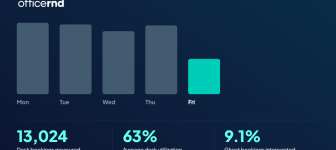
A full year of hybrid work data, taken from our own Workplace product analytics.

OfficeRnD Flex vs Nexudus on pricing, features, and real G2 reviews.

OfficeRnD Workplace vs Robin, full comparison: pricing, adoption, coordination and fit