Helpdesk Is Live in OfficeRnD Workplace. Here’s the Problem We Built It For.

5 mins read Published: Sep 15, 2026 Last updated: Sep 15, 2026
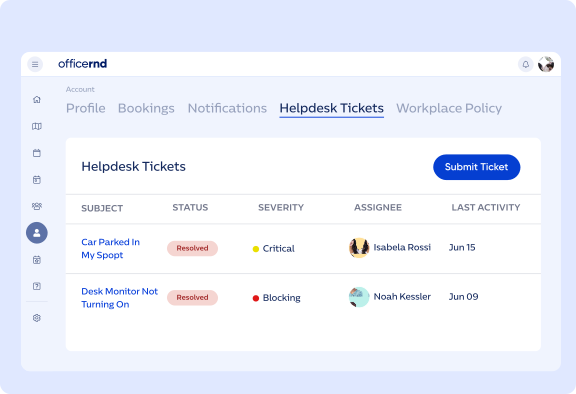
Imagine the following scenario for a bit: a meeting room display stops working on a Tuesday morning. Four teams had that room booked. One standup moves to the kitchen, one call gets taken from a phone booth, and by 11am three people have mentioned the problem to the office manager in passing. Nobody writes it down. The display gets fixed on Thursday, or the following week, or after the fifth person complains.
We’ve shipped desk booking, room booking, parking and visitor management for years, and workplace requests kept arriving the same way they always have: Slack DMs, hallway conversations, a shared inbox nobody owns.

So we built Helpdesk. It’s live in OfficeRnD Workplace now, in the same web portal and mobile app your team already uses to book a desk.
Here’s the thinking behind it.
We ran 12 months of our own office data through OfficeRnD Workplace and looked at what a week actually does. Monday averaged 73.3% desk utilization. Friday averaged 36.2% – roughly double, every week, for a year.

That gap changes the job of a facilities team. Coffee, cleaning cycles, meeting room hardware, phone booths, printers and parking get consumed on 3 days instead of 5. The same faulty display costs twice as much on a Tuesday as it does on a Friday, measured in people who can’t do the thing they came in for.
The midweek shape isn’t specific to us. WFH Research has tracked working-from-home days across dozens of countries since 2020, and the pattern of a compressed in-office core holds broadly.
Gallup finds hybrid is now the standing arrangement for most remote-capable employees, so this is the load profile workplace teams will be managing for years, not for a quarter.
Most workplace problems are reported verbally, and verbal reports don’t accumulate.
Three people tell you the chair in the quiet zone is broken. You fix it. Six weeks later someone tells you again, and you have no way of knowing whether it’s the same chair, the same fault, or the third repair on the same unit. The office manager carries the entire maintenance history in their head, and it leaves with them when they go on holiday.

The second cost shows up at budget time. A workplace lead asking for 12,000 EUR of new meeting room hardware brings observations. Finance brings a spreadsheet. Without a record of how often rooms failed, which ones, and how many bookings were affected, the request looks like a preference rather than a repair schedule.
And employees stop reporting. Not because they’ve stopped caring, but because the last four things they mentioned produced no visible response. Silence trains people out of the habit, and then the workplace team loses the only sensor it had.
One finding from our own year of data sits directly under this.
We never assigned team neighborhoods in our Sofia office. Nobody gave Marketing a corner or Engineering a bank of desks. Teams formed neighborhoods anyway, in the old office, and then again in the new one after we moved. People don’t book desks as individuals. They move as a unit.
Which means wear concentrates. The zones that fill up on Tuesday are the zones where monitor arms loosen, cables disappear and chairs give out. A request with a location attached turns “the chairs are getting old” into “7 tickets from the same desk bank since March.” That’s a purchase order.
You can see which areas run hottest in space management. Helpdesk tells you what breaks there.
Helpdesk runs inside OfficeRnD Workplace, alongside desks, rooms, parking and visitors. No separate tool, no second login, no new app for employees to forget about.

Here’s what it offers:
There’s a precedent in our own numbers for what happens when you start recording something you used to ignore.
Every desk booking in our office requires a check-in. Miss it and the booking auto-cancels, returning the desk to the pool. Over the year, 9.1% of bookings were caught that way. That’s about 4.5 desks recovered every working day, roughly 8% of the office’s capacity, from one policy setting applied to behavior that used to be invisible.
Workplace requests sit in the same category. Right now, most of them exist only as a memory, and you can’t schedule, budget or plan against a memory.
Give them a form field and a timestamp, and within a month you have a picture of your office that no walkthrough will give you. Workplace analytics does the rest.
Helpdesk is available now to OfficeRnD Workplace customers. If you want to see how it fits with desk booking, rooms, parking and visitor management, and what your first month of ticket data would tell you, the fastest route is a 30-minute call with our team.


![14 Best Space Management Software Tested and Compared [2026]](data:image/svg+xml;base64,PHN2ZyB2aWV3Qm94PSIwIDAgMTE1MiA3MTkiIHdpZHRoPSIxMTUyIiBoZWlnaHQ9IjcxOSIgeG1sbnM9Imh0dHA6Ly93d3cudzMub3JnLzIwMDAvc3ZnIj48L3N2Zz4=)
The best space management software in 2026 is OfficeRnD Workplace. This is a complete buyer's guide.

The average flex operator connects 1.65 of 5 core systems. See what the gap costs and how to fix it.
A 2-site coworking operator shares how OfficeRnD's AI Sales Agent handles inquiries.
A full year of hybrid work data, taken from our own Workplace product analytics.
OfficeRnD Flex vs Nexudus on pricing, features, and real G2 reviews.
OfficeRnD Workplace vs Robin, full comparison: pricing, adoption, coordination and fit