Free Meeting Room Booking Template in Excel [2026]

9 mins read Published: May 22, 2023 Last updated: Aug 24, 2026
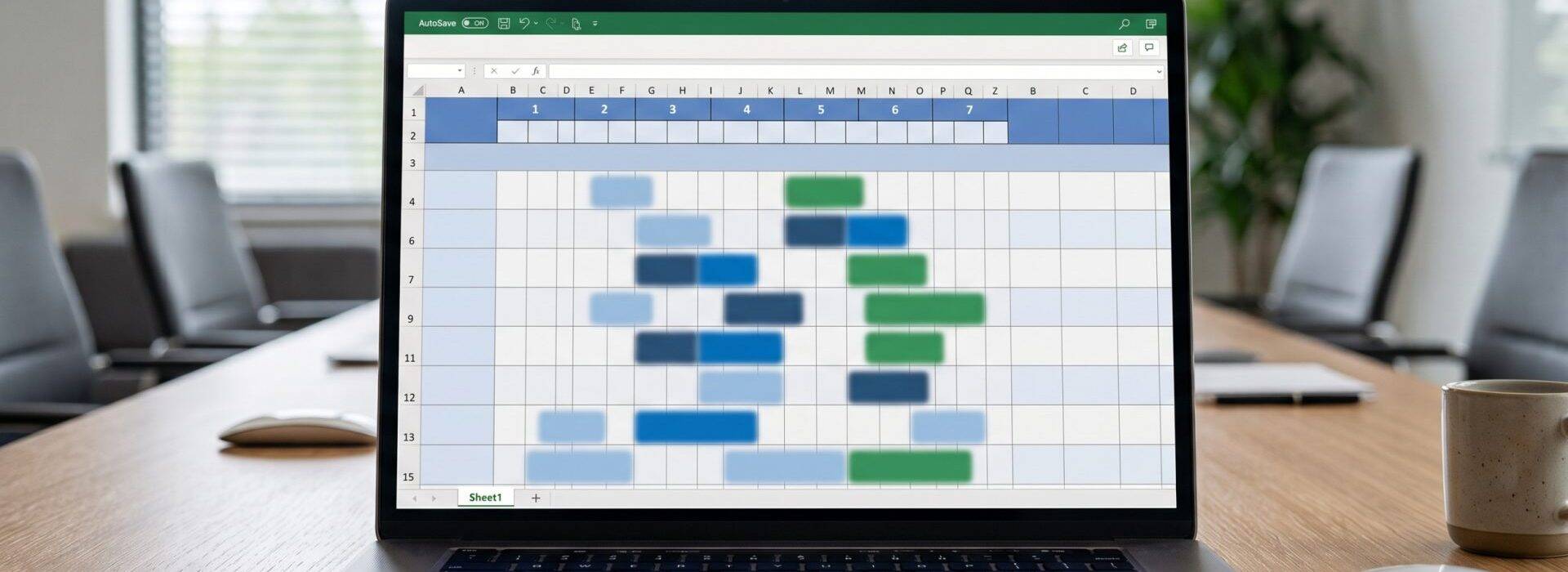
TL;DR:
Two teams arrive at the same room at 10 am. One of them booked it three weeks ago in a shared calendar. The other wrote it on a whiteboard by the kitchen. Somebody moves to a corridor.
Sounds familiar, right?

Most free spreadsheets stop that from happening twice. This meeting room booking template in Excel goes further: it records whether anyone turned up, then tells you what your rooms are doing with the rest of the week.
Same file, same formulas, no macros. Pair it with our desk booking template in Excel if you need both, then use our RFP template when you’re ready to compare proper tools.

Six tabs, in the order you’ll use them.

The limits, stated plainly: 12 rooms, 30 people, one office, 200 bookings across 10 working days, and a bookable day of 16 half-hour slots. Past that, look at meeting room booking software instead.
Fifteen minutes in total, start to finish.
In Google Sheets, use File, then Make a copy, so it saves to your own Drive. In Excel, download the file and put it on SharePoint or OneDrive if more than one person will edit it. Emailing the file around is how a booking system dies in week 3.

Open Setup. Type your room names, the floor or zone, how many people each room seats, and what’s in it. Video conf, whiteboard, huddle, focus room.
Fill in the Seats column. It drives the room right-sizing report on the Dashboard, and it’s the number most people skip.
Then add your people. Those names fill the dropdowns on the Bookings tab.
Set your bookable day while you’re there. The default runs 9:00 to 17:00, which gives every room 8 bookable hours a day. Change the start time and all 16 half-hour slots move with it.
Set “Bookings start” to a Monday. Every date on every other tab updates from that one cell. Leave it alone and it defaults to this week’s Monday.
Go to Bookings. Add the date, room, start time, end time, who booked it, what it’s for, and how many people are coming.
Use a clean time format, 14:00 or 2:00 PM, and keep it consistent down the column.
Two columns then do the checking for you:
The Day Board shows you where a conflict sits, so you can move one of the two meetings 30 minutes and be done.
The next morning, go back to yesterday’s rows and set “Took place?” to Yes or No-show.
This is the step people skip, and it’s the step that makes every number on the Dashboard mean something. Two minutes a day.
One person, named, with a backup. Office manager, workplace coordinator, or whoever already fields the “is the big room free?” question.
In Google Sheets, give the owner Editor rights and everyone else Commenter rights if you want bookings requested rather than made. Room names change more often than people expect, and one person keeping the Setup tab current is what stops the rest of the file drifting.
Fourteen numbers sit across the top of the Dashboard. Six of them decide what you do next.

Below those, four tables do the thinking.
Utilization by day gives you the 10 working days in a row, with a bar per day. The shape of your week averages Monday to Friday across both weeks, which is the table to screenshot for your leadership team.
Utilization by room ranks every room by hours booked, with its seats and average attendee count next to it. Who books the rooms lists your people by meetings, hours, and no-shows, which settles arguments about who is holding the big room every Thursday.
The right-sizing block splits your two weeks into 6 counts: meetings for 1 to 2 people, meetings for 3 to 5, meetings for 6 or more, bookings in a much bigger room than needed, bookings with more people than seats, and bookings where nobody turned up.

Most offices run the same pattern. A pile of 1-to-1s and 2-person calls, a solid middle of 3-to-5 team meetings, and a handful of larger sessions that fail whenever the big room is taken.
Two people sitting in a room built for 12 is the commonest kind of waste in an office, and it’s invisible until you count it.
The market has been moving the same way. JLL’s 2026 Global Occupancy Planning Benchmark Report records private offices continuing to decline while phone booths, focus rooms and small meeting rooms take their place, and makes the point that knowing whether those rooms work needs space-level utilization data rather than building-level badge counts.
At 12 rooms, this template is that data. If your 1-to-2 count is high and your empty-seats-per-meeting number is 6 or 7, you don’t need a bigger office. You need to turn one large room into two small ones.
The Dashboard’s time-slot table breaks your bookable day into half hours and shows the share of rooms in use at each one.
Almost every office finds the same shape. Microsoft’s Work Trend Index research on the infinite workday found that half of all meetings land between 9-11am and 1-3pm, that Tuesday now carries 23% of the week’s meetings against Friday’s 16%, and that 60% of meetings are ad hoc, with 1 in 10 booked right before it starts.
Room shortages are a problem with about 4 hours of the day, on about 3 days of the week.
Our own office says the same thing from the other direction. We run OfficeRnD Workplace on our own floor, and across the year to July 2026 our Tuesday utilization was 71.5% against Friday’s 37.2%.
The same meeting rooms serve nearly twice as many people on a Tuesday as on a Friday. The full year-by-year breakdown sits in our desk booking template article.
Two things follow for your rooms.
First, a room no-show costs more than a desk no-show.
In our own office, 9.2% of desk bookings were auto-canceled because nobody checked in. A missed desk booking wastes one seat.
An abandoned booking on an 8-person room blocks 8 people from meeting, usually at 10am on a Tuesday, which is the exact hour and the exact day when nothing else is free. That’s what the “Took place?” column is for, and it’s why a room no-show rate above 10% is worth acting on before you go looking for more space.
Second, recurring meetings run against the grain of hybrid attendance.
74.6% of the office attendance we measured was booked one-off, week by week, rather than on a repeating pattern. Standing meetings do the opposite: they repeat forever, and in a two-week grid you retype every one of them each fortnight. Log the recurring set first, then add the ad-hoc bookings on top.
If you ever need to calculate how much office space you need, check out our office space calculator.
Most free meeting room templates are a weekly grid with a booking table under it. This one goes further in 6 places.
| Typical free template | This template | |
|---|---|---|
| Formats | Google Sheets only, or Excel only | Excel and Google Sheets, one file |
| Email gate | Often | No |
| Rooms | 1 room per view | Up to 12, all visible on one board |
| Conflict detection | Manual check, or a basic flag | Automatic, plus wrong-time and out-of-range checks |
| Capacity checking | None | Flags over-capacity and oversized bookings |
| No-show tracking | None | Per booking, with a rate on the dashboard |
| Utilization reporting | None | By room, by day, by weekday and by half-hour slot |
| Views | One weekly grid | All rooms for one day, plus one room for two weeks |
The right-sizing report is the part with the most money attached. A template that stops double bookings saves an argument. A template that tells you 3 of your rooms only ever hold 2 people tells you what to do with your next fit-out.
Every function in the file (COUNTIF, COUNTIFS, SUMIF, INDEX, MATCH, SUMPRODUCT) works in both. Choose on how your team works.
| Excel | Google sheets | |
|---|---|---|
| Several people booking at once | Needs SharePoint or OneDrive | Works out of the box |
| Offline access | Yes | No |
| Booking from a phone | Workable, not comfortable | Better |
| Calendar | Outlook | Google Calendar |
| Version history | Manual, or via OneDrive | Automatic |
| Conflict checks and dashboard | Same | Same |
Short version: Sheets if more than 3 people will touch the file in a day. Excel if you’re the only editor, or if IT keeps everything inside Microsoft 365.
The file is honest about its ceiling. Here are the signs you’ve hit it.
Meeting volume is part of why this arrives faster than teams expect. Organizations have seen a 12.9% rise in the number of meetings per employee since 2020, and none of that growth lands evenly across the week.
There’s also a quieter problem. When we polled our audience, 30% were on hybrid work software, 11% ran bookings on a spreadsheet, and 17.4% had built something in-house.
Answers from the same company often disagreed, because different teams were running different systems. If sales books rooms in Outlook and engineering keeps a sheet, you have three booking systems and none of them can tell you how full the office was on Tuesday.
Also, here’s an image showing the main pros and cons of using a meeting room booking excel sheet.

Every tab in the template exists because software does the same job on its own. Here’s the mapping.
| Template tab | OfficeRnD Workplace |
|---|---|
| Bookings | Book from your Microsoft or Google tech stack with the room locked the moment it’s taken |
| Status column | Real-time availability, so a clash can’t be created in the first place |
| Took place? | Check-in on a room display, with unclaimed rooms released back to the pool automatically |
| Day board | Interactive floor plans with real rooms in real positions |
| Room week | Recurring, multi-room and private bookings, handled once |
| Dashboard | Room analytics across months, floors and locations |
| The tabs you’d have to build | Desks, parking and visitors in the same place |
The automatic release is the piece a spreadsheet can’t reproduce. Our 9.2% figure came from one setting: check-in required, auto-cancel on miss. In a spreadsheet, that same result takes a person walking the floor.
Naming your rooms well helps more than it sounds, too. Our list of meeting room name ideas is there when you get to it, and better room data usually ends in a smaller office footprint.


![14 Best Space Management Software Tested and Compared [2026]](data:image/svg+xml;base64,PHN2ZyB2aWV3Qm94PSIwIDAgMTE1MiA3MTkiIHdpZHRoPSIxMTUyIiBoZWlnaHQ9IjcxOSIgeG1sbnM9Imh0dHA6Ly93d3cudzMub3JnLzIwMDAvc3ZnIj48L3N2Zz4=)
The best space management software in 2026 is OfficeRnD Workplace. This is a complete buyer's guide.

The average flex operator connects 1.65 of 5 core systems. See what the gap costs and how to fix it.
A 2-site coworking operator shares how OfficeRnD's AI Sales Agent handles inquiries.
A full year of hybrid work data, taken from our own Workplace product analytics.
OfficeRnD Flex vs Nexudus on pricing, features, and real G2 reviews.
OfficeRnD Workplace vs Robin, full comparison: pricing, adoption, coordination and fit